

Vinyl records are designed to last. That durability is part of their appeal: a record can survive changing formats, changing owners and decades of listening. It can move from a family shelf to a secondhand shop and remain useful long after the original release campaign ends. But durability creates a harder question when a record is damaged, warped, badly scratched or commercially obsolete. What happens when the object can no longer be played, sold or reasonably donated?
In June 2026, Warner Music Group and a group of independent U.S. record stores launched a take-back pilot for damaged and unplayable records. The program followed a manufacturing study involving Warner Music Group, GZ Media and Abbey Road Studios that tested whether recovered record material could be incorporated into new commercial pressings without lowering expected sound quality. Together, the projects move vinyl sustainability beyond vague promises and toward practical questions about collection, sorting, transport, manufacturing and scale.
This does not make vinyl environmentally harmless, and it does not prove that every old record can immediately become a new one. It does show that the format’s future may depend on more than collecting special editions. For the Infamouz music desk, the important story is how a beloved physical format can keep its cultural value while becoming less wasteful.
Why the Vinyl Industry Is Testing a Take-Back System
Damaged Records Have Few Clear Routes After Use
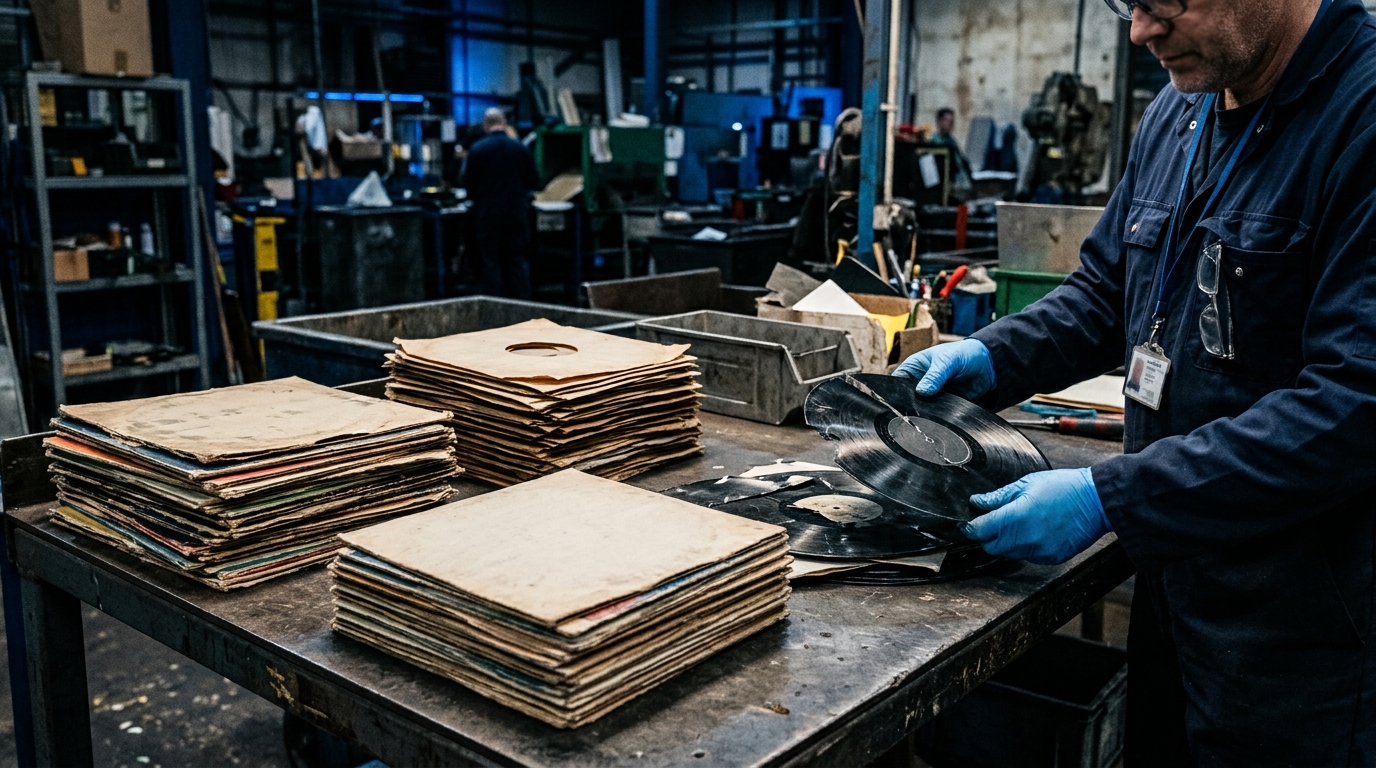
A playable record usually has a second life. It can be sold, traded, donated or handed to another listener. The used-record economy is one of vinyl’s strongest practical advantages because ownership can circulate instead of ending after one consumer. The problem begins with records that are no longer desirable or playable. Deep scratches, heat damage, severe warping and broken edges can make resale unrealistic. Unsold and obsolete label inventory creates a separate but related stream of material.
Many household recycling programs are not designed to accept records. Vinyl records are generally made from polyvinyl chloride, commonly called PVC, and local plastic rules vary. A recycling symbol or the word “vinyl” does not mean an item belongs in a curbside bin. Consumers need a verified collection route, not a hopeful guess.
What the 2026 Store Pilot Is Measuring
The Warner Music Group take-back pilot began at the end of June 2026 and was scheduled to run through September. Participating independent stores were asked to accept damaged or unplayable records regardless of artist, label or condition. The collected material would be consolidated and evaluated through recovery partner Virterras Materials.
The pilot is designed to examine participation, material quality, transportation, processing requirements and potential recovery outcomes. Those details determine whether a collection idea can become a repeatable system. A bin in a shop is easy to imagine; moving heavy material from several cities, identifying contamination, storing it safely and delivering a consistent feedstock to a processor is much harder.
Independent record shops are also logical collection points. They already sit between labels, artists and listeners, and they understand what stock can be resold and which records have no realistic market. A take-back program uses that relationship instead of asking consumers to understand industrial material systems on their own.
Why Collection Is Harder Than Shredding a Record
Recycling conversations often jump directly to the final transformation: an old record is shredded and becomes a new pressing. The middle stages decide whether that outcome is practical. Records arrive with paper labels, sleeves, jackets, inserts, dust, adhesives and unknown storage histories. Some returned items may still be playable and should remain in circulation rather than being destroyed.
Transport can also erase part of the benefit. Vinyl is dense, and moving small quantities over long distances may require more handling than centralized factory scrap. The industry therefore has to compare the benefit of recovered material with the energy and emissions from collection, warehousing, sorting and shipping.
This is why the pilot should be treated as research rather than a completed national recycling solution. It can reveal participation patterns and operational barriers, but it cannot yet guarantee permanent collection at every store or a closed-loop destination for every returned record. Readers should check a shop’s current instructions before bringing material.
Recovered Vinyl Can Meet Commercial Audio Standards
The take-back project follows a May 2026 manufacturing test focused on unsold records rather than consumer returns. Approximately 10,000 records from different artists, titles and pressing plants were processed. The material was shredded and used in test pressings with recycled-content ratios ranging from 10% to 100%.
What the Sound-Quality Study Proved—and What It Did Not
According to the study announcement from Warner Music Group and GZ Media, blind listening evaluations coordinated with Abbey Road Studios found that recovered material could be incorporated into commercial-grade pressings while maintaining expected sound and production standards. The project also modeled potential carbon reductions of more than 10% compared with a virgin-material baseline under the conditions tested.
That matters because recycled material will not be adopted widely if it creates unreliable noise, inconsistent surfaces or higher rejection rates. The tests suggest that recovered PVC does not automatically require a lower-quality product.
The limits are equally important. The study used controlled manufacturing conditions and unsold records, which are easier to trace than damaged records collected from the public. The modeled carbon improvement depended on the tested process, and the organizers acknowledged added steps including transport, warehousing, sorting and shredding. One successful pilot does not prove that every recycled pressing has the same footprint or performs identically in every plant.
The story also should not become another collectible gimmick. A label could market “recycled vinyl” while pressing unnecessary variants, using elaborate packaging or shipping small batches by air. Sustainability depends on the whole production decision, not one material claim printed on a sticker.
What a More Sustainable Vinyl Culture Actually Requires
Reuse Comes Before Recycling, and Better Production Comes Before Hype
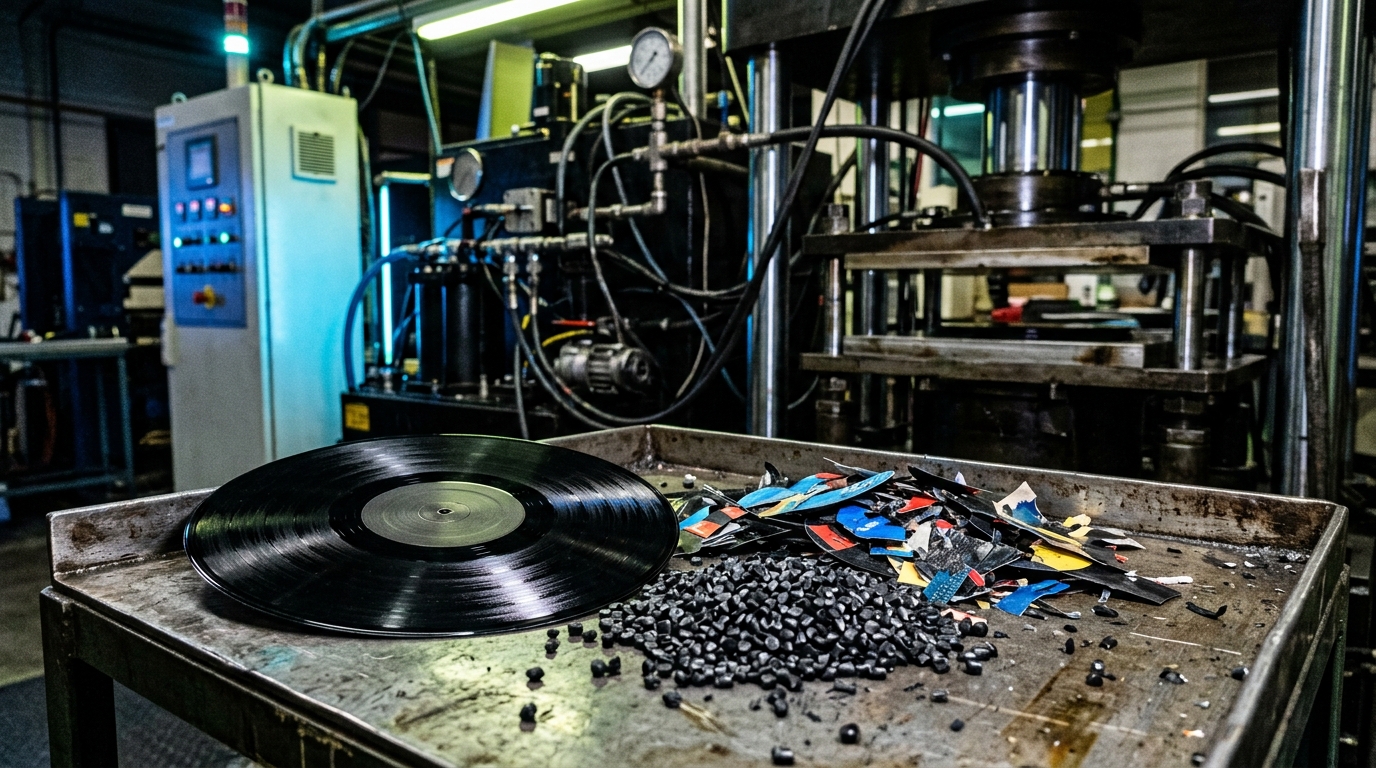
The best outcome for a playable record is usually continued use. Selling, trading, donating and sharing preserve the music and the manufacturing already invested in the object. Recycling becomes appropriate when condition or demand makes reuse unrealistic. Collectors should avoid destroying playable records merely because a recycling campaign feels new.
For artists and labels, the larger responsibility begins before manufacturing. The Vinyl Record Manufacturers’ Association and Vinyl Alliance carbon-footprinting report estimated a cradle-to-factory-gate footprint of about 1.15 kilograms of carbon-dioxide equivalent for the record it analyzed. In that study, PVC compound accounted for about half of manufacturing emissions, factory energy for roughly 30%, and print packaging for around 13%. The report also found that heavier vinyl and elaborate packaging could increase the footprint, while air freight could become a major additional source of emissions.
A Practical Hierarchy for Artists, Shops and Listeners
Artists and labels can press realistic quantities instead of treating excess inventory as proof of success. A smaller run that sells through is better than thousands of unsold units waiting for recovery. They can favor standard-weight records, simpler packaging, local or regional production where possible, slower shipping and transparent manufacturing data. Recycled content is valuable, but it should sit inside a wider plan.
Record stores can keep resale, donation and recovery streams separate. Staff need clear guidance on what remains playable, what is accepted by a pilot and what packaging must be removed. Stores also deserve support for labor and storage; collection programs should not transfer the entire operational burden to small retailers while labels receive the public credit.
Listeners can buy fewer records with more intention, care for them properly and use the secondhand market. Store records vertically, avoid excessive heat, replace damaged inner sleeves and clean them with appropriate tools. When a record is beyond use, verify a take-back route instead of placing it in ordinary recycling.
Infamouz has already examined how abundance can weaken meaning in our story about AI-generated music uploads. Vinyl presents the opposite physical problem: every unnecessary copy requires real material, energy, packaging and transport. The answer is not to shame collectors. It is to make fewer careless objects and build better systems for the damaged ones that remain.
Vinyl’s
Vinyl’s next chapter will not be secured by nostalgia alone. The format survives because people value the listening ritual, artwork, ownership and social life around record shops. Recycling can support that culture, but only when backed by credible testing, practical collection and honest accounting. The most sustainable record is one that is wanted, played and passed on. The next best outcome is a damaged record with a verified route back into useful material.
Future reporting on the culture desk and in the Infamouz archive should follow the pilot’s results, participating-store feedback and any permanent recovery system that emerges. Until those findings are public, “recyclable vinyl” should be treated as a promising direction—not a finished solution.