Social media can consume an hour without feeling like an hour. A creator opens an app to check one reference, watches a short video, reads a comment thread, saves three ideas and returns to the original task with less energy than before. Because the session felt absorbing, it is tempting to call it “flow.” That label matters, because flow is usually associated with deep involvement, clear progress and the satisfaction of using skill toward a demanding goal. Endless scrolling can produce immersion, but immersion alone is not the same experience.
A 2026 field study titled “Flow on Social Media? Rarer Than You’d Think” followed 40 participants for five days, combining smartphone-use tracking with daily reconstruction of activities that produced flow. Across 673 reported flow experiences, only 2% were associated with social media. Heavier social-media use also predicted fewer flow occurrences during the day. The researchers correctly described their findings as initial evidence rather than a final verdict: the study was small, short and observational, so it cannot prove that social media directly caused people to lose flow.
Even with those limitations, the result captures a familiar problem for writers, musicians, designers, photographers and developers. Social platforms are useful for discovering work, meeting collaborators and reaching audiences, yet their default rhythm rarely matches the conditions needed to make something difficult. The issue is not that creative people must abandon social media. It is that discovery, publishing and conversation should not be confused with the protected work of creating.
Why Scrolling Feels Absorbing Without Becoming Creative Flow
Flow Has a Goal, While the Feed Keeps Moving the Goal
Flow is usually discussed as a state of concentrated involvement in an activity where challenge and ability are reasonably balanced. The person knows what they are trying to do, receives feedback from the activity and can keep adjusting. A guitarist hears whether a phrase works. A writer can feel a paragraph becoming clearer. A designer sees whether the hierarchy holds together. Progress may be difficult, but the task has direction.
A social feed works differently. Its goal is open-ended continuation. The user does not finish Instagram, TikTok, X or a recommendation feed in the way a person finishes a sketch, a verse or a software component. Every item creates another possible direction: respond, save, compare, search, share or move on. The platform can hold attention while repeatedly changing the object of attention.
What the 2026 Field Study Actually Found
The 2026 flow study did not rely only on participants estimating their general habits. It combined objective smartphone application tracking with daily accounts of activities that participants experienced as flow-inducing. Social media appeared in a very small portion of those accounts. Activities such as work, study, sport, hobbies and other goal-directed experiences were more commonly associated with flow.
People can spend substantial time on an activity without describing it as one of the day’s best periods of concentration. A feed may be compelling because it offers novelty and social information, not because it supports sustained creative progress. The study also found relationships involving fatigue, mood and motivation, but it does not justify claiming that every additional minute of social use damages creativity. Purpose, platform and context still matter.
Absorption Is Not the Same as Progress
Creators should be careful with the phrase “I was researching.” Social platforms can provide legitimate references: a photographer may find a lighting approach, a musician may encounter an unfamiliar genre, or a writer may notice how people describe an emerging issue. Research becomes avoidance when collecting possibilities replaces choosing and developing one of them.
A practical test is whether the session leaves an external result. Did you write a usable note, save a source with context, contact a real collaborator, make a decision or change the work? If the answer is no, the session may have generated stimulation rather than progress. That does not make it morally wrong. Rest and entertainment have value. The problem begins when stimulation is repeatedly counted as creative labor.
This distinction belongs in the broader Infamouz internet desk, alongside our articles on automated web traffic and AI crawlers consuming independent websites. A human creative process requires excluding most possibilities long enough to develop one.
Notifications and Repeated Checking Break Continuity
Creative work rarely collapses because of one dramatic interruption. More often, it is weakened by small cues that keep part of the mind prepared to switch. A phone lights up. A notification preview appears. The creator checks whether a post is performing, returns to the draft, then checks again before the original line of thought is fully rebuilt.
A 2026 study in Computers in Human Behavior, “Attention Hijacked: How Social Media Notifications Disrupt Cognitive Processing,” tested smartphone-style notifications while participants performed a cognitive task. The researchers reported a temporary slowdown following alerts and found that disruption was related to notification relevance and patterns of frequent checking. Their work suggests that the number of interruptions and learned checking habits can matter more than a simple total-screen-time number.
Why Checking Frequency Matters More Than a Daily Total
Two people can each spend one hour on social media and experience very different effects. One may use a scheduled hour after finishing work. The other may divide the same hour into dozens of checks throughout writing, editing and conversation. The second pattern repeatedly introduces a new decision: open or ignore, answer or postpone, compare or continue. The total is identical, but the fragmentation is not.
A screen-time target alone may fail. A creator can remain below a daily limit while still allowing alerts to interrupt every important work block. A better measure is how often the session is broken and how long it takes to regain context. People differ, so no universal recovery time should be treated as fact. Continuity has value, and frequent checking spends it.
How Creators Can Use Social Media Without Letting It Run the Process
Build Separate Modes for Making, Researching and Publishing
The realistic alternative is not total withdrawal. Independent creators often need social platforms because audiences, opportunities and peers are there. The stronger approach is to define what the platform is for before opening it. Research mode gathers specific references. Publishing mode uploads finished work and handles necessary responses. Community mode supports intentional conversation. Making mode happens elsewhere and remains protected from all three.
Start each research session with a written question. Instead of “look for inspiration,” use “find three examples of low-light portrait composition” or “identify two primary sources for this essay.” Set an endpoint based on the result, then transfer useful information into a notebook or project file.
A Practical Flow-First Routine
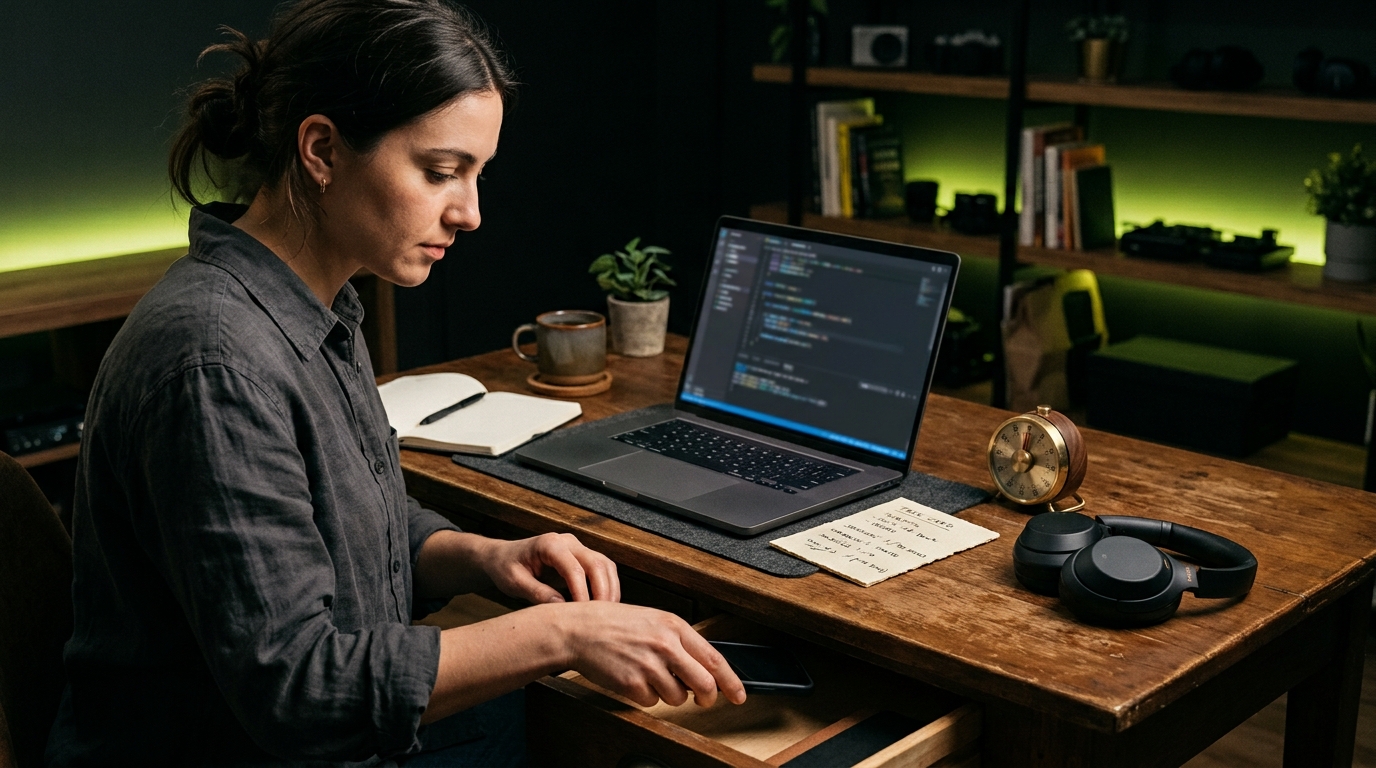
Before a creative block, place the phone outside immediate reach or use a focus mode that allows only genuinely urgent contacts. Close social tabs, disable desktop notifications and write the next concrete action where it remains visible. “Work on the article” is vague; “draft the section explaining why checking frequency matters” gives the mind a target. Choose a block long enough to settle into the task, but appropriate to your energy and responsibilities.
Keep a capture list for impulses that arise during work. When you want to search for a reference, check a message or publish an update, write it down instead of switching immediately. Review the list after the block. This preserves useful ideas without allowing each one to become a detour.
After creating, use a separate distribution window. Post the work, answer important comments and record useful audience feedback, then leave. Do not make the first minutes of public reaction the final judge of the piece. Platform metrics are influenced by timing, existing reach, recommendation systems and automated activity, as our bot-traffic guide explains. They can inform distribution, but they cannot measure the full value of an essay, image or song.
Independent websites
Independent websites, newsletters and direct archives remain valuable because they allow work to keep its context. A social post can point toward a complete article in the Infamouz essays desk, while the permanent version remains available through the archive. This turns the platform into a doorway rather than the only room where the work exists.
Social media can produce real connection, learning and occasional moments of focused participation. The 2026 field study does not prove that flow on a platform is impossible, and creators should not use it to diagnose themselves or shame other people’s habits. Its more useful message is that prolonged engagement should not automatically be mistaken for an optimal experience.
Creative flow is built from clear intention, manageable challenge, feedback and continuity. Social platforms are built around movement between stimuli. Those systems can cooperate when creators assign each one a job. Use the feed to discover, communicate and distribute. Use a protected space to think, practice, revise and finish. The goal is not to become invisible online. It is to make sure being visible does not replace making something worth seeing.