
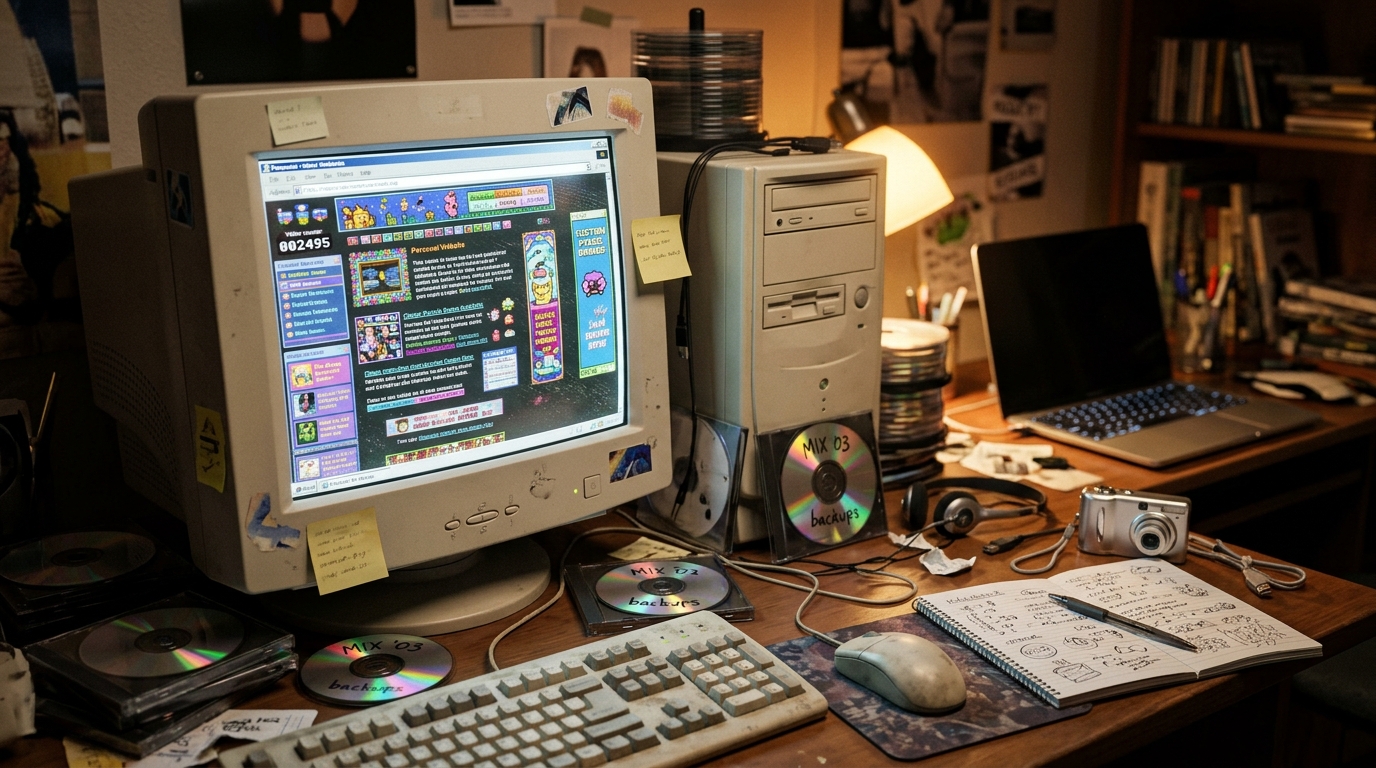
Not every old website was beautiful or useful. Many were difficult to navigate, poorly maintained or filled with broken links.
Nevertheless, those imperfections reveal how individuals experimented with digital identity before standardized social-media profiles became dominant.
Today, internet preservation projects such as the Wayback Machine make it possible to revisit portions of that history. However, not every website was captured, and archived versions may be incomplete.
This article explores why personal websites still matter, what digital archives can preserve and how creators can protect their own work.
Personal Websites in 2026: What the Old Web Offered
The early personal web was not a single unified culture. Different communities used websites for different reasons, including fan discussions, music discovery, visual art, technology experiments and personal writing.
However, one recurring feature was the freedom to organize a page around individual interests.
Creative Identity Before Standardized Social Profiles
Personal websites offered a way to construct a public identity through design and content.
Page backgrounds, buttons, illustrations and navigation choices communicated personality alongside written words.
Why Imperfect Websites Felt Personal
Before contemporary website builders and social-media templates became widespread, many creators learned basic HTML by experimenting.
Some used animated graphics, textured backgrounds and handwritten navigation menus.
Others built simple pages containing photographs, poems, music lists or detailed descriptions of favorite films.
The results were frequently inconsistent.
However, that inconsistency was part of the medium’s identity.
One website might resemble a scrapbook, while another felt like a miniature magazine.
Because creators controlled more of the page layout, their interests influenced both the content and the experience of browsing.
That freedom could be exciting, but it also created accessibility and usability problems.
Low-contrast text, flashing animations and complicated navigation sometimes excluded users.
Modern independent websites can retain creative freedom while applying better standards for accessibility and performance.
Preserving the spirit of the old web does not require reproducing every technical limitation.
Guestbooks, Webrings and Independent Communities
Personal websites also connected through systems that differed from today’s centralized feeds.
Guestbooks allowed visitors to leave public messages for a site’s owner.
Webrings connected websites devoted to similar interests through shared navigation links.
Blogrolls gave readers a way to discover other writers through personal recommendations.
These systems did not eliminate popularity contests or social hierarchies.
However, they offered ways for smaller communities to form outside a single platform’s recommendation system.
For underground music scenes, independent pages could distribute news, photographs, reviews and event details.
Fan communities could create detailed archives long before major social platforms became their default gathering places.
The relationship between pages mattered as much as the pages themselves.
A link represented an editorial decision: someone chose to point readers toward another person’s work.
That context is often missing when old websites are viewed as isolated screenshots.

What Digital Archives Can and Cannot Preserve
The Wayback Machine, operated by the Internet Archive, allows people to explore archived versions of websites.
Visitors can enter a web address and browse available captures from different dates.
However, it is not a complete recording of the internet.
How the Wayback Machine Preserves Web History
The Internet Archive collects publicly accessible web pages through automated crawls and other archiving methods.
Individual users can also submit public URLs through its Save Page Now feature.
That tool creates a capture of a specific page when the system can access it.
However, saving one page does not automatically archive an entire website.
The Internet Archive’s own documentation explains that Save Page Now does not initiate a complete crawl of every linked page.
Therefore, a home page may survive while older articles, photographs or downloadable files remain missing.
Archived captures also reflect particular moments in time.
If a website changed between crawls, some versions may never have been saved.
Nevertheless, even incomplete captures can be culturally valuable.
They may preserve artwork, language, design choices and community references that no longer exist on the live web.
The Internet Archive’s official guide explains how to explore saved websites.
Why Some Old Pages and Images Disappear
A website may be absent from the archive for several reasons.
Automated crawlers may never have discovered it.
The site may have been password protected, inaccessible or excluded from archiving.
Its images may have been hosted on a different server that was not captured.
Dynamic content can also be difficult to preserve.
For example, an old page may require a server-side program or external service that no longer exists.
Even when the visual layout survives, interactive features may fail.
The Internet Archive notes that JavaScript and other dynamic technologies can complicate historical reconstruction.
Consequently, an archived website should not always be treated as a perfect copy of what visitors experienced at the time.
Researchers should examine capture dates and consider which elements may be missing.
This is particularly important when an archived page is used as evidence for cultural history.
How to Preserve Independent Internet Culture Today
Digital preservation is not only a task for large institutions.
Writers, musicians, photographers and website owners can make practical decisions that improve the chances their work survives.
Archiving Your Work and Building a Personal Website
The Library of Congress recommends identifying important online materials, exporting them, organizing files and maintaining multiple copies.
Its guidance provides a useful starting point for individual creators.
Identify what deserves preservation.
Begin with original writing, photographs, artwork, interviews, recordings and website projects.
Include relevant context such as publication dates, contributors and permissions.
Not every social media comment or temporary file needs to become part of a permanent archive.
However, materials that document an important creative project may deserve long-term attention.
Choose deliberately rather than saving everything without organization.
Export content from platforms where possible.
Some social platforms and website services allow users to export data.
These files may include photographs, posts and other account information.
However, export formats differ, and certain features may not be preserved.
Check whether exported files open correctly before relying on them.
Do not assume a platform will remain available indefinitely.
Likewise, do not rely on the Wayback Machine as the only backup of a website you control.
Our article about AI crawlers and independent websites examines another reason creators may want greater control over their published work.

Organize files with useful context.
The Library of Congress recommends descriptive filenames and a clear folder structure.
For example, photographs from a music event can be stored with the event date, location and photographer’s name.
Essays can be preserved with publication dates and revision history.
Without that context, old files may become difficult to identify years later.
A simple text document explaining the archive’s structure can be valuable.
It helps future readers understand the collection without relying on the original creator’s memory.
Keep copies in different places.
A single external drive can fail, be lost or become inaccessible.
Multiple copies reduce the risk of losing important files because of one failure.
The Library of Congress recommends storing copies on separate media and in different locations.
It also advises periodically checking that files remain readable.
However, preserving personal information requires appropriate privacy protections.
Do not publish private correspondence or sensitive materials simply because they have historical interest.
Permission and consent matter when archives contain other people’s contributions.
Create a website that is easy to preserve.
A simple website can remain distinctive without relying on complicated interactive systems.
Clear navigation, descriptive links, accessible HTML and properly labeled images improve usability.
They can also make content easier to understand when certain visual elements fail to load.
Use stable article addresses and maintain backups of the site’s content and media.
For important work, consider saving a copy through the Wayback Machine.
However, remember that a single saved page is not a full-site backup.
Keep a relationship with your audience.
Independent websites can work alongside social platforms rather than replacing them completely.
An artist might share a photograph through a social feed while publishing the complete project on a personal website.
A writer might promote an essay through a short post while preserving the full argument at a stable address.
This allows readers to discover work through multiple channels.
However, the permanent version remains easier to find outside a changing recommendation system.
For related context, read Why Social Media Rarely Creates Real Creative Flow.
Why independent archives need editorial responsibility.
Preservation is not simply the act of copying everything available.
Archives may contain personal information, copyrighted work and material published in a different social context.
Creators and researchers should consider privacy, attribution and permissions.
They should also distinguish original material from later commentary.
An archived photograph without context can easily produce a misleading interpretation.
Responsible preservation aims to keep the record available while explaining what is known and what remains uncertain.
What does the future of personal websites look like?
Independent websites are unlikely to replace every major social platform.
Most people appreciate the convenience of centralized communication and discovery.
However, personal websites can provide a complementary space where creative work remains organized around the author’s priorities.
They allow individual publishing styles to exist outside standardized profile layouts.
That independence may become increasingly valuable as online platforms evolve.
Frequently asked questions
Are personal websites still relevant in 2026?
Yes. They offer creators control over presentation, organization and long-term access to their work.
Can the Wayback Machine recover every deleted website?
No. Many pages were never captured, and archived versions may be incomplete.
Can I submit a page for archiving?
Yes. Save Page Now can capture eligible public web pages, but it does not automatically save an entire website.
Is an archived website a reliable backup?
Not by itself. Site owners should maintain their own copies of important files.
Final thoughts
Personal websites in 2026 matter because they preserve a different idea of internet culture: people publishing on their own terms.
Digital archives help recover fragments of that history, but they cannot save everything.
For independent creators, the strongest approach combines original publishing, responsible preservation and practical file management.
The old web was imperfect. Its lasting lesson is that the internet can still make room for individual voices, unconventional design and communities built through genuine shared interests.
Editorial note: Historical web captures may be incomplete. Check dates, authorship and permissions before republishing archived material.